Parenting in the age of smartphones and the internet

Our youngest child turned 21 a couple months ago. Serious parenting is over for us. Our experiences differ in many ways from those my parents had a generation ago. The most significant difference stems from the advent of smartphones. We became an iPhone family in July 2007 when the first generation iPhone was released. My wife, Karen, our two oldest children, and I signed up in quick order before the end of that year. Only our youngest, at nine years old, had to wait. But really only for one year. All the children of most families we knew had smartphones by age 11 or 12.

Smartphones provided our children a higher degree of autonomy for them and well-being for me and Karen.  So long as they responsibly took care of their iPhones and carried them as they engaged in extracurricular activities or went out with friends we let them do things on their own. They were only a quick text or phone call check in away. Less wondering where the kids were or what they were up to on the parenting side of the equation.

Back in the days Karen and I went out the only way for parents to check in was through land line phones, or, while traveling, by postcards.  I took one trip to Hong Kong, the Philippines and Australia in the late 70’s. The itinerary I gave my parents had us staying at a hotel in Manilla.  On the second day our itinerary said we’d be at a hotel that had a bomb go off killing several people in the hotel lobby. Unbeknownst to my parents I didn’t check in to that hotel.  My traveling friend Jim and I had met up with a friend of ours in Manilla and she invited us to stay with her family while  there. A fortuitous change in travel plans. I didn’t hear the news about the bombing locally, but my parents were sick with worry until I finally checked in with them when our travels got us to Brisbane, Australia.

Here are a few anecdotes about how smartphones kept us connected with our kids.

FaceTime calls from Veronica from India

In 2015 Veronica stopped out from Stanford for a term to travel to the northern India town of McLeod Gange.  Her travels were not easy for a single young woman.  It was helpful for her and us that she could Facetime us from halfway around the world at any time of day to let us know she was ok or to work out changes in her travel plans. The age of the video phone call had finally arrived and we were very thankful for it. Veronica was as well.

Texting from San Francisco flight to Paris while Abbey is flying back to Boston

In May 2016 Abbey did a revisit to Oberlin College as part of her college selection process. As it turned out Karen and I were traveling to Paris from San Francisco the day she left Oberlin to travel back to her school in Concord, New Hampshire.  Her flights back were Cleveland to La Guardia and then La Guardia to Boston arriving by 3:30pm so she could catch the scheduled 5:00pm airporter bus back to school.  Best laid plans.

Abbey’s flight out of Cleveland was delayed due to a mechanical issue and then due to weather. She arrived over two hours late to La Guardia missing her scheduled connection to Boston. She was good enough to text us as the frustrating delays mounted.  Surprisingly, were were able to receive her text messages while on our United flight airborne over Canada.  By the time she landed in La Guardia our flight was over Greenland. She continued to text us and we continued to receive the texts.  She was able to get rebooked on the last flight to Boston that evening, but needed to navigate the airport to get to her new gate.  She arrived at gate C8 and was leaving at gate C20.  We thought that was a simple walk along the C concourse. But Abbey started texting us about having to take a bus and we misconstrued her texts at the time that she was going to take a bus from LGA to BOS.  As you can see from the map below she indeed needed to take a bus, but from one C Concourse to a second…only at LGA. What a mess of an airport.

Abbey’s late night route from one C Concourse to another at LGA.

Anyway, we were frantically texting her as we flew over Greenland and she was confused about how to get to her next flight.  In the end, she made that last flight, arrived in Boston near midnight, and took an Uber ride 70miles to Concord arriving about 1am in the morning east coast time. The Uber option in today’s world was another saving grace.

Tracking Veronica’s hike along the John Muir trail

Our oldest daughter graduated from college in 2016.  In late June of that year she made a 217 mile hike over 17 days along the John Muir Trail, a small portion of the Pacific Crest Trail, with one of her good college friends, Emily.  We, along with Emily’s parents, were concerned for their safety hiking in such a remote area for so long.

The girls purchased a satellite syncing GPS device to take with them.  Each day at 5pm it would automatically turn on and send us, the parents, a new location code.  So long as we saw it progressing south along the trail when we entered the location code into Google maps we could relax and assume all was going well, or at least ok.  The map below shows the progress we mapped.  The hike did go well and technology kept us parents relatively relaxed.

Veronica and Emily’s Satellite GPS coordinate daily posts as they hiked the John Muir Trail.

Funding text requests from my girls as my plane is taxiing down the runway

One of the deeply nested corollaries to Murpy’s Law has to be that your daughter will text you in dire need of funds at the same moment your two hour flight is taxiing or actually accelerating for take off.  I believe this has happened to me over five times in the past three years.  Amazingly enough, in each instance I have been able to get logged in to my BofA account and have the funds transfers made. In these days WiFi was still not available during flights. Now our ability to be connected at all times, even while flying, is almost a given.

Chronic Cracked Screens

Finally, the biggest problem we had was keeping our girls from having cracked iPhone screens.  After about three for each of our girls we said the next one is at your cost.  That would be a big hit to their allowance. It was surprising how long each felt they could go dealing with cracked screens before they sought replacement. Whenever I saw them with friends I’d survey how many of their friends had cracked screens. Often it was most of them.
Posted in Current Issues, Social Issues, Technology | Leave a comment

Waiting Without Worries

When was the last time you were upset about the length of a line?

It’s been a while ago for me. Perhaps as far back as 2006 since I’ve had a smartphone (read iPhone) in my possession. With decent cell or wifi connections waiting doesn’t stress me out anymore. There’s always current news, the latest sports scores, a Kindle book or a random app to check in with. As our society gets increasingly dense and busy this presents a welcome stress reliever.

I don’t even mind getting to the airport early anymore. Always something to do on my phone or tablet in the waiting area plus less stress that I might miss my flight.  When a flight is delayed I move into zen mode and calmly dive into my smartphone to wile away the time.

I’m in a world of my own in grocery store lines. The DMV doesn’t scare me as much, although their glacial pace is still astonishing.  A visit to the doctor or dentist provides a quiet respite in their waiting room before an appointment.

Of course, all of these situations imply I’m traveling or waiting alone. When I’m with others face time conversations are the priority. It’s more than just a matter of etiquette.  Someone has invested their valuable time to be with you, you need to be with them, in the present.


Posted in Current Issues, Social Issues, Technology | Leave a comment

When I Do and Do Not Wear a Bike Helmet

Cycling is my primary mode of transportation after air transit. Each time I get on a bike I have the choice of wearing a bike helmet, or not. I don’t wear a bike helmet each and every time I get on a bike.  I wear a bike helmet selectively, just not on each and every ride.  So when do I wear one and why?

Like many, riding a bike came to me early in life.  I spent a good portion of my early teen years toodling around town with friends on my ten-speed. In those days wearing a bike helmet wasn’t something we thought about. It never happened.  I didn’t own a helmet. My parents never thought about buying me one.  But then this was also the era of riding in cars without a seat belt. Safety standards have changed. Also like many, riding disappeared from my life when I turned sixteen, got my driver’s license, and a car. Unlike many, I returned to cycling in a big way in my late forties.

Urban living has made cycling not only a realistic transportation choice, but often a more efficient and timely mode of transit. It was also a lifestyle choice for me brought on by a strong feeling that I needed more regular exercise. I hate running for exercise. I enjoy cycling in all of its forms.  I have a collection of bikes.

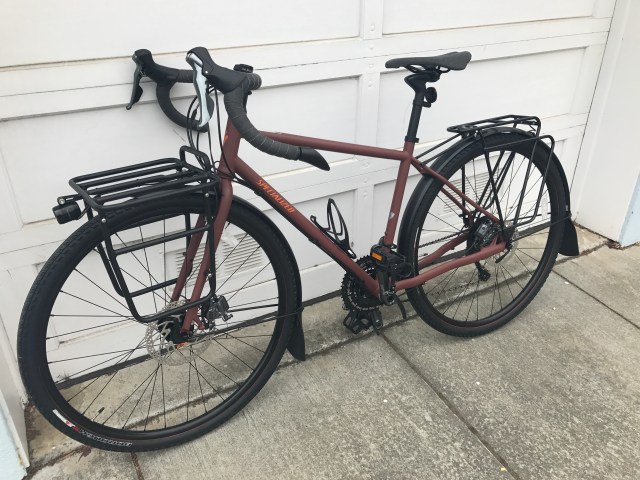
My Specialized AWOL touring bike for serious rides

My Brompton folding bike for leisure and travel

My choice of ride depends on whether I am interested in exercise, running errands, or just trying to get somewhere.

I almost always wear a bike helmet when I’m out and about on my touring bike. I use this bike primarily for exercise and longer rides of more than five miles at a time. I average about 14-15mph during these rides. The high average speed and forward leaning riding position make wearing a helmet a safety necessity.

Conversely, I almost never wear a bike helmet when I’m using my Brompton folding bike. The riding position is much more upright and it is easy to step on and off quickly. It is great for short errands. I average about 9-10mph on this bike. Exercise is less the reason. The focus is just on getting there.

Speed is the major factor, in my opinion, in head injury or fatality risks associated with cycling. There are two perspectives on speed:

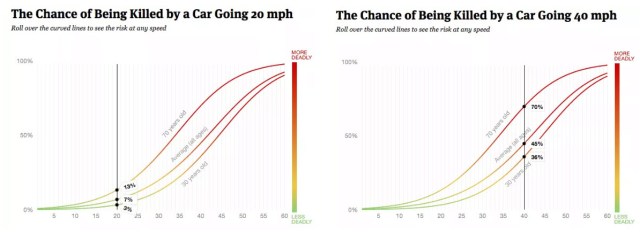
First, there is the risk of injury or fatality associated with the speed of cars in a collision.  A car collision with a cyclist (or pedestrian) raises the risk of injury to the cyclist (or pedestrian) exponentially with the speed of the car.  The speed of a cyclist (or pedestrian) is essentially irrelevant.

Car Deaths at 20+40mph

Second, there is the speed of the cyclist in non-car related crashes. There are no clear third-party statistics I could find on this.  My personal experience suggests I am far less likely to incur a serious injury while traveling at 10mph than at 15 or 20mph.  Reaction time is one factor here, but more importantly the type of bicycle and riding posture are important factors as well. When I am riding on my Brompton at a slower speed (8-10mph) and in an upright posture with a low crossbar the risk of injury is tremendously lower than if I am riding my touring bike at 15+mph in a hunched over posture (more aerodynamic) and with a high crossbar.

Articles on Cycling and Helmet Use

Bike Helmet Statistics from helmets.org

Pedestrian and Bicyclist Crash Statistics

Why doesn’t the Dutch bike culture include helmets?

UK Pedal Cyclist Injury Statistics

Posted in Cycling, Health and Hygiene | Leave a comment

Building Community Prepares Us for any Future

I’m often told that I’m not positive enough because I point out all sorts of deficiencies in the world without offering solutions. This irritates me. Perhaps this irritability reinforces my reputation as a curmudgeon. Deep cleansing breaths. In with the good air. Out with the bad. Squeeze the little rubber ball. Okay… First, some problems simply […]

via How to Ride the Slide: Apocalypse Lite — Granola Shotgun

Posted in Current Issues, Social Issues | Leave a comment

Form vs Function – A Sexist Cycling Anecdote

A few weeks ago my wife, Karen, invited me to join her on a trek to the East Bay to ride the Iron Horse Trail. She was participating in a women’s meet up to ride from Pleasant Hill to Danville and back. From prior meet ups with this group male participants weren’t actively encouraged to join the group, but weren’t disbarred either. I went along to ride the trail on my own.

We rode BART from the 24th and Mission Street station in San Francisco to the Pleasant Hill station on the Pittsburg/Bay Point Line. About a 45 minute ride. We secured our bikes to the BART car, mine against the rail and Karen’s outward next to mine. A little ways after emerging from the Transbay tube a young Japanese woman approached us and coyly asked if she could take a picture of Karen’s bike. Karen rides a blue Public Mixte with a wicker basket on the handlebars sporting a fine bouquet of flowers. The woman clearly appreciated the style of Karen’s bike.

Karen's Public Mixte with Wicker Basket

Karen’s Public Mixte with Wicker Basket

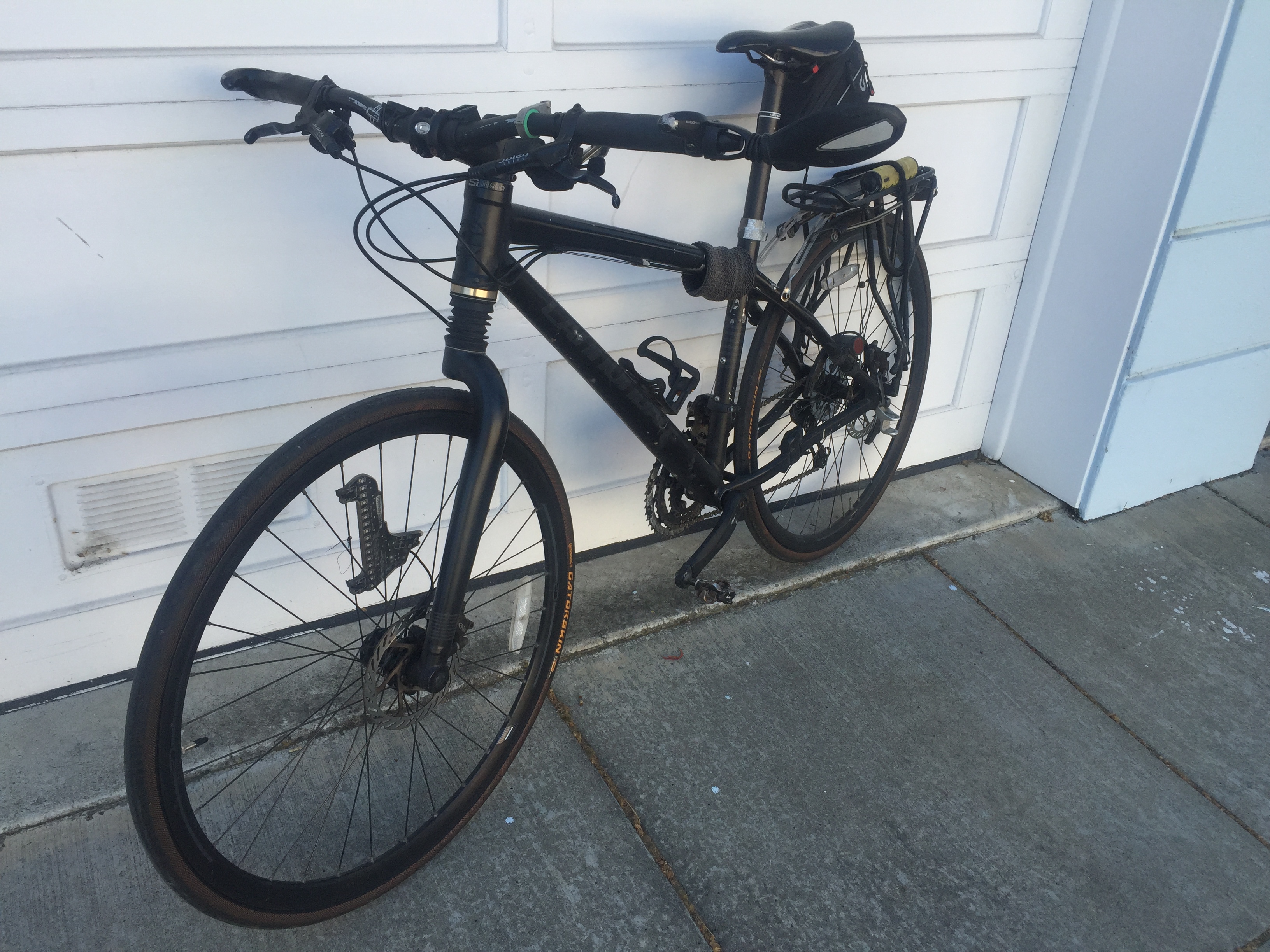
I commented to Karen that her bike was quite attractive to women, whereas men preferred functional bikes. While that would have been the end of it, my opinion was confirmed later during our BART ride to Pleasant Hill. One of the bikes I ride is a Cannondale Bad Boy Ultra. All flat black, head to toe, including the aluminum tire rims. It also sports a lefty fork, the front wheel is attached with only a single left fork; rarely seen in the US.

Peter's Cannondale Bad Boy Ultra

Peter’s Cannondale Bad Boy Ultra

As we approached the Orinda station a man sitting across from us traveling with a military back pack and wearing desert war sand colored boots got up, hoisted his back pack and then asked me about my bike’s lefty fork. He said he had never seen something like that before and wondered how well it worked. I told him this was popular in Europe, that I had had the bike for five years and it worked well for me. He also asked if the fork had a shock absorber. I told him yes with a switchable lock accessed from the top of the fork. He was impressed. He showed no interest in Karen’s bike, although it was closer to him.

The Japanese woman clearly showed interest in Karen’s bike due to form while the man showed interest in my bike primarily due to function. A sexist experience involving cycling interests.

Posted in Current Issues, Cycling, Social Issues | Leave a comment

Cycling Calms Cities

Cycling calms cities. A bold claim. Stick with me for a few paragraphs and perhaps I can persuade you. I’ll be moving into my third decade of cycling in San Francisco this fall. Twenty plus years provides plenty of perspective on changes in societal behaviors; cycling or otherwise. Particularly in a large city like San Francisco. The most striking behavioral change with respect to cycling I have seen and experienced is that it has calmed the city. From a transportation perspective, anyway. Clearly, cycling is on the rise. Prior to 1994, with the exception of Critical Mass, started in San Francisco in 1992, there were really no significant bike first initiatives anywhere. Riding a bicycle was something you did when you were a kid… and never, or rarely, again. Certainly not for anything so mundane as just getting yourself from point A to point B.

Cycling not an option? Cycling not an option?

When my wife and I moved back to the San Francisco Bay Area in 1994, with two kids in tow, we chose to live in San Francisco proper, not one of the outlying suburbs. We wanted to experience the city and knew we could always move to Marin, the East Bay or the Peninsula if it didn’t work out. We’re still in SF and a one kid larger family unit to boot! In 1996, I participated as a volunteer in my first Bike to Work Day. One of the key initiatives at that time was an effort to make Valencia Street, from its start at Market Street heading south to Cesar Chavez (nee Army St around that time) more bike friendly. I assisted the then director of the SF Bicycle Coalition, Dave Snyder, with laying out traffic cones along the first mile of this two mile route to convert the then two lane two way street with no bike lanes into a single lane each way with a center turn lane experience for cars and a single bike lane each way next to the parked cars. Following this day’s experiment the SFBC was able to get experimental striping laid down the whole length of Valencia Street in roughly this same format. Six months later, with a little nail biting and trepidation that the SF Planning Commission would get cold feet, the experimental striping was made permanent. There was plenty of store owner griping that business would fall off, but to date, clearly, this change transformed Valencia into a thriving urban mecca for fine food and shopping. And it shows no signs of slacking off.

Last year, the evolution of Valencia Street advanced a bit further with the introduction of a ‘green wave’, timed lights for all traffic going north and south at roughly 13mph. Valencia Street Cycling slows down life in this neighborhood. More human scale. Cyclists, initially, made all drivers mad. Now only a few. Many drivers today wave me through intersections first. They’re courteous!

1994 to 2004: Decade of the hard core cyclist… messenger men, middle-age men in Lycra (MAMIL’s) careening through traffic with little respect for cars and traffic laws.

2004 to 2014: Decade of cycling ascendancy … the growing inclusion of women and cycling as a useful mode of transportation. City planners actively incorporating safer cycling options across cityscapes.

2014 to today: Decade of cycling acceptance. Cycling as a regular transportation mode is here to stay. Parents regularly taking their children to school on bikes. Strong growth in electric bikes.

Posted in Current Issues, Cycling, Social Issues | Leave a comment

Cycling Saga: Heads vs Tails

It’s early spring in Iowa after a harsher than usual winter highlighted by a ‘polar vortex’. Last winter I was able to do four or five Iowa rides in January and February. This year, none. I was determined to get at least one ride in before the end of the first quarter of the year, so I set out on a blustery, overcast, cool day with the threat of rain looming in the forecast. With a choice of directions to set off in, I chose heading south into a fairly steady 15mph wind gusting to 20 or 25mph, so that I would have the wind at my back on the return. It’s not often I get a chance to record the effect of wind on a ride, but this time was optimal.

What a difference the wind makes

What a difference the wind makes

The nine mile ride to Ely, Iowa into the wind brought tears to my eyes, even behind my cycling glasses, along with a wind chill bringing the effective temperature down to the low 30’s numbing my fingers and toes. Nearly 45 minutes uphill and into the wind. Doesn’t it always feel that way? The return was a completely different feeling. You don’t necessarily feel the wind pushing you along, but the wind chill effect disappeared. I comfortably rode along, about 5mph on average, faster than the headwind leg with a return trip time about 13 minutes faster. About a 29% time savings over the outbound leg. Even though the absolute temperature was falling from 41 degrees to 37 degrees during the ride I felt much warmer on the return leg. What an effect the wind can have!

I don’t know when I’ll be testing my resolve in conditions like this in the future, but this ride set an expectation for me I won’t soon forget. Let’s get some better weather soon, already.

Posted in Cycling, Sports and Exercise | Tagged , | Leave a comment

The Living Room of the Future

I had the opportunity to visit Deerfield Academy a while ago with my daughter as she was visiting a former school friend of hers. Abbey had finnagled a way to spend the night on campus, which I was not averse to, but I had to wait on approval for me to leave her. I was invited into the faculty quarters of the dorm she was staying at. The dorm master’s husband introduced himself to me and kindly worked through the approval process. During the visit our conversation turned to the books he had in his living room. He said he and his wife owned over 4,000 books and, of course, didn’t have room to display them all. The ones on his living room shelves were a select set that conveyed a broad sense of what was important to him and his wife’s life. I perused his book shelves while he stepped out of the room for a dorm hall check. One shelf was filled with books on archaeology and near eastern history. Another had hard bound copies of classical authors and playwrights. I was able to engage in some enjoyable conversation with him, a stranger up until that evening, upon his return, based on what I had seen. He seemed easily pleased I had taken the time to review his collection and express interest in certain topics dear to him and his wife.

This experience got me to thinking about how the living room of the future may change. With books disappearing into Kindle Readers, Barnes & Noble Nooks, iPads, etc will there come a day when books on shelves won’t be part of the domestic landscape? Will this depersonalize the private living spaces of people we visit? What social queues will we begin to rely on instead of books to generate a sense of who people are? Does this really matter?

My wife and I are avid readers. Each of the major rooms of our home — living room, family room, kitchen and all the bedrooms — have book shelves brimming with books. That being said I can count on one hand the number of new hard or soft bound books I have purchased over the last four years. It’s not that I’ve stopped reading, I just get them through Amazon and read them on my Kindle account. New physical book purchases have become a rarity and highly selective process for titles we feel are keepers or represent coffee table heirlooms.

For someone entering our living room today the books on our shelves represent a lost moment in time some five or six years ago before we stopped purchasing real books. The room’s collection is not continuing to evolve as we evolve in our tastes and values. When our children settle down and furnish living rooms of their own will they include books in them? I am afraid they won’t. Without shelves what will they adorn their walls with? What will these decorations say about them that a couple hundred books might have said instead?

What we wear is a statement about who we are and what we value. What we drive, or don’t drive, can be a statement of who we are and what we value. The music we play makes a statement as well. How we decorate our home is a statement of who we are and what we value. Without books on display I feel it may be harder to get to know someone. In addition, there is a certain aesthetic richness I feel when I enter a room full of books. It feels more engaging, more intimate in some way. Without shelves of books showing a variety of book spines of varying heights and colors I fear there will be some diminished enjoyment in the room’s décor.

Posted in Lifestyle Issues | Tagged , | Leave a comment

Origami and Kayaking – My Saga – Part 2

(Continued from Part 1 in this series).

This is a January to remember.  No rain. Nary a drop. Least amount of precipitation in a year in the Bay Area in recorded history.  On the one hand I am taking advantage of this wondrous weather by cycling and kayaking every day possible in these deep winter months.  On the other hand I know these ideal conditions are terrible creating a terrible drought we’ll pay the consequences of in months to come.

Having taken the Oru kayak out on Christmas day morning, the sole boat on San Francisco Bay around the Hyde Street Pier, I felt I was now ready to get the cycle trailering option working.

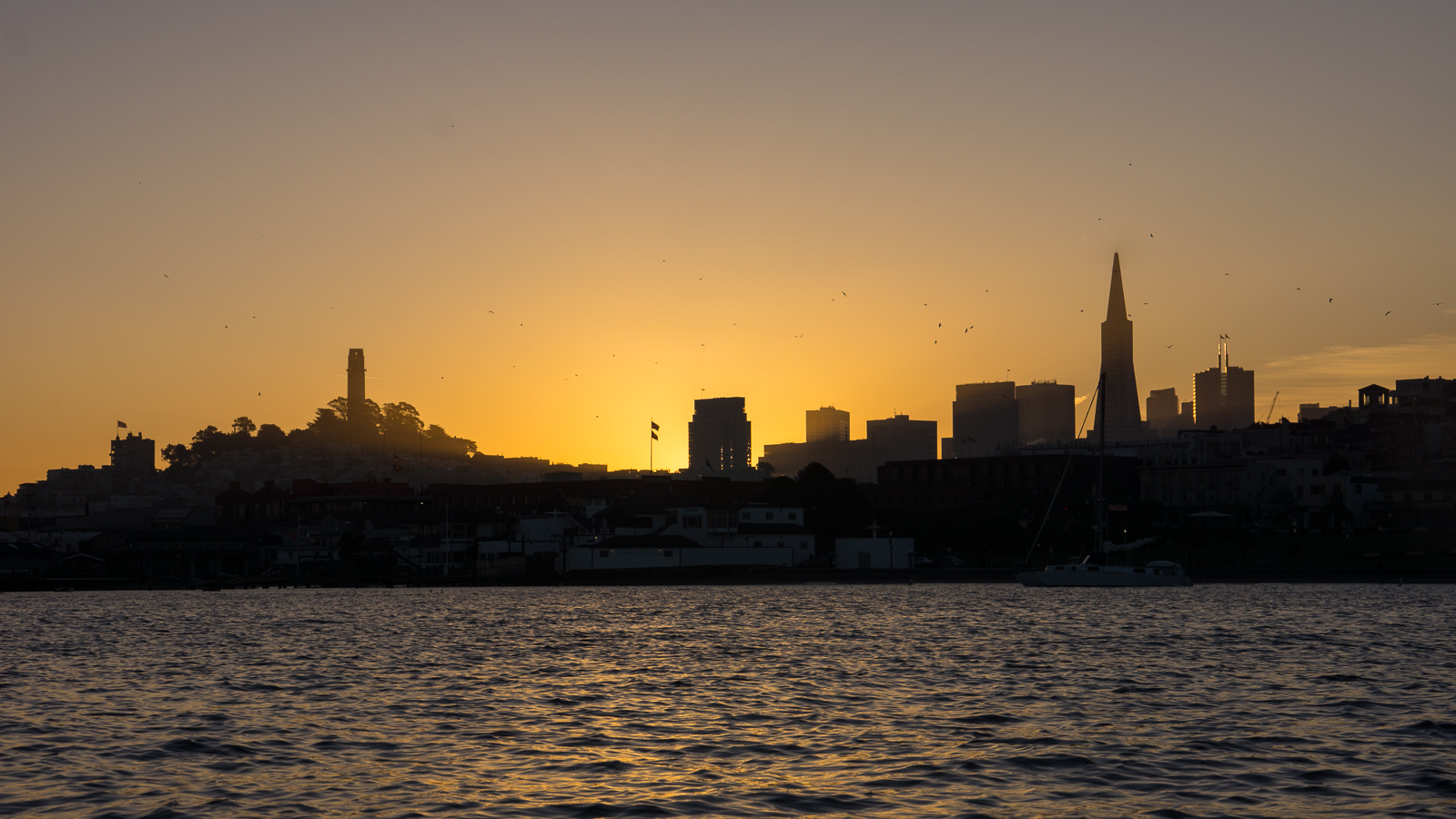
Xmas morning sunrise skyline

Xmas morning sunrise skyline

Online research for trailering options dredged up several $100 options, but they all said they wouldn’t work with quick release skewers or had seat post attachments that wouldn’t accommodate the shape of the folded Oru kayak.  At the other end of the spectrum were some awesome trailers fitting my needs perfectly, but running upwards of $350 to $600.  I finally settled on a Burley trailer option in the $250 price range, a little higher than I had budgeted.  I ordered it through Amazon on a Sunday evening and was surprised to see it show up at our house through UPS the next afternoon.  Perhaps the post Xmas delivery speed was a carry over from the holiday delivery mania.

I built the Burley trailer pretty quickly and then waited until the following weekend to try trailering the kayak.  Having only bungee cords at hand in my garage I was able to tie down the folded Oru Kayak atop the trailer.  Our house sits on a pretty good hill so any route is downhill at first.  I took off tentatively, listening to new sounds from the trailer and load following behind me over SF’s rutted roads.  After traveling downhill to 24th and Castro via Diamond Street I checked on the load and found, as I had feared, the kayak had shifted forward several inches and threatened my back wheel.  I righted the set up, took off again and headed straight to Cole Hardware at 29th and Mission for other tie down options.  A set of trailer straps, nine feet each in length, proved to be the best option.  They had no give to them and held the kayak firmly in position on the trailer as I then made my way to China Basin (Pier 52) via Cesar Chavez Street.

Arriving safely. Kayak in tow

Arriving safely. Kayak in tow

The challenge with cycling to kayak is securing everything you brought with you from theft while on the water. Either it stays ashore unattended or comes with you somewhere on or in the kayak. I locked my bike normally and then dealt with the trailer. How to keep it or parts of it from being stolen? I removed the quick release wheels and locked them and the frame to the rear wheel of my bicycle. My travel pannier from my bike rack thankfully fit fine into the back of the kayak. I was good to go.

Stowing away in the aft cabin of the kayak

Stowing away in the aft cabin of the kayak

I was now getting more comfortable launching from a pier without having to get my feet wet on a sandy beach. I paddled north out of China Basin toward the AT&T Ballpark. Not sure I’ll ever find myself floating off right field waiting for a splash homer, but it is fun to see the stadium from the water.

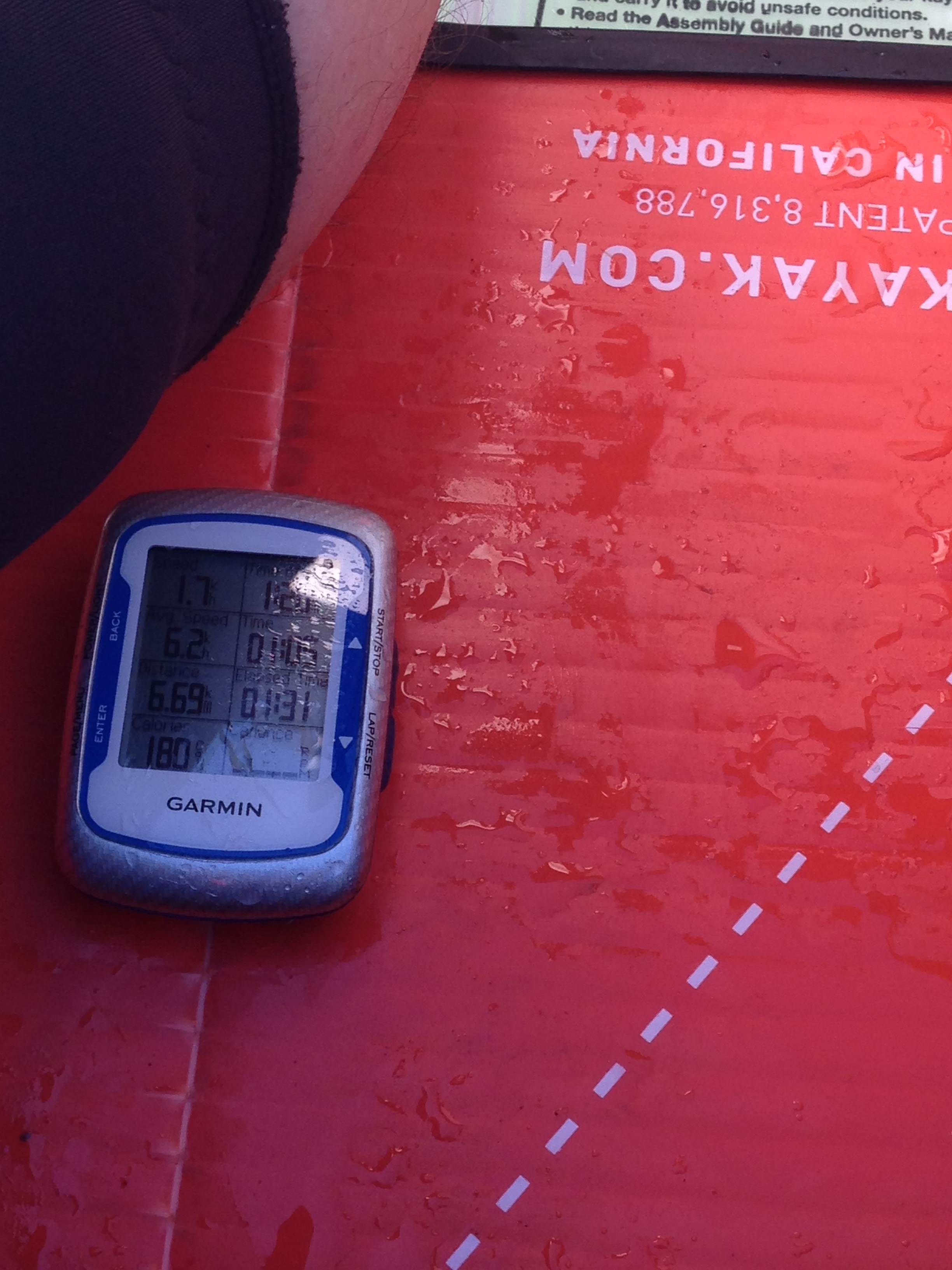
I had found my Garmin GPS worked fine in the kayak tracking my route and measuring my pace. A cutout in the floor plate of the Oru Kayak held my GPS steady as I paddled.

Tracking my Oru Kayak trips with the Garmin Edge 500 GPS

Tracking my Oru Kayak trips with the Garmin Edge 500 GPS

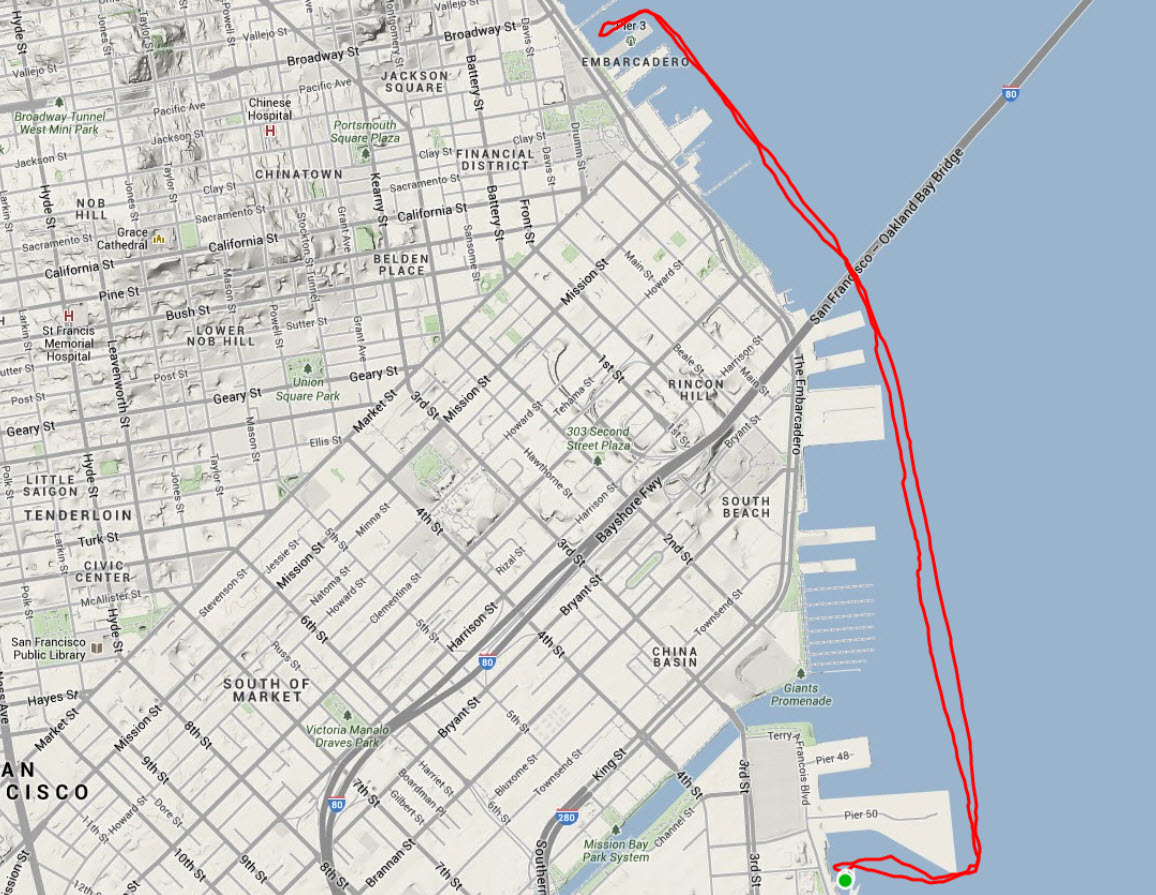
Over my previous five sojourns around the SF waterfront I was gaining more confidence and upper body strength. My pace was averaging about 4mph and after three trips I was able to sustain this rate for up to an hour at a time. Here’s the route I took this past weekend. 5.5 miles out and back.

Kayak Route: China Basin Pier 52 to Exploratorium

Kayak Route: China Basin Pier 52 to Exploratorium

Out on the open water I found the waves varying from nearly placid to sizeable two or three foot rolling swells created, no doubt, by the big oil tankers that made their way south along the bay’s trade routes. While the Oru Kayak is a little more tippy than others I have used I found riding these swells and other boat wakes not too difficult. Overall, I continued to be surprised by how few boats seemed to be on the water at any point in time.

Setting up and repacking the Oru Kayak is taking me less and less time each trip. The biggest delay I have is time taken to talk with passers-by interested in discussing their kayaking experiences or seeing how the folding kayak concept works. Adds about 15 minutes for me on either end of my trip, but I enjoy each conversation.

Starting at sea level means that any final destination is uphill. For me this means a 300 foot climb to my house with the last city block about an 18% grade. While I can always walk that last block I felt I needed to challenge myself and try the hill at least once with the kayak and trailer in tow. It was a struggle, but I was able to conquer it. A satisfying end to my cycling and kayak trek for the day.

Posted in Health and Hygiene, Lifestyle Issues, Sports and Exercise, Uncategorized | Tagged | 7 Comments

Zero to 6000 in 5 Years

(Long Post)
It’s January 2009. I’ve just turned 50 a couple of months ago. I weigh over 200 pounds and I’m 5’6″ tall on a good day. My mother is terminally ill and on the other side of the country. The US has recently suffered a serious financial meltdown, but elected its first black president, Barak Obama. My family business has suffered a significant financial setback from the worst flood in the history of its home town, Cedar Rapids. Where do I go from here?

Sitting idly by, watching playoff football and eating another pint of ice cream sounds really soothing. But I am not feeling well. My business will suffer a significant sales shortfall in the coming year ( in real terms it does work out to a 25% decline ). My personal health is not good. I’m stressed and I’ve got some uncomfortable gastro-intestinal issues, high blood pressure, and a couch potato mentality. Time to do something different.

Crises have a way of focusing your thinking. January 2009 was that period of crisis that focused mine. For some peculiar reason I latched onto the idea that if my business could suffer through a significant sales decline I could personally reduce my weight by a similar amount. I resolved, that January, at a mid-life turning point, to take control of my physical well-being first and let the chips fall where they may with other parts of my life.

I had been riding my bike to work for several years now. But riding to work was a direct substitution for taking public transit and I found I could only really do the 3.5 mile ride two or three times per week and by the most direct routes. Doing more than that made my knees hurt and I found it difficult to take the 88 steps each evening up to the front door coming home.

So what changed? First, I enrolled in a calorie counting program called Lose It! and started counting calories. Second, I committed to riding my bike to work, no matter how slow, five days a week. Bike riding became a spiritual as well as a physical outlet for me. Finally, coping with my mother’s eventual death in February 2009, I resolved to slow my life down and put my personal well-being at the center of my priorities.

Over the next 12 months the calorie counting fixation got me to make tangible changes in my eating habits and marginal changes in my exercise routines. I joined a health club at my office to augment my three day per week rides to and from the office. In April of 2009 I made a mini-discovery. If I covered my knees during ALL of my bike rides the sore knees issue went away. Sounds weird, but it worked. I bought of couple of calf length bike riding pants and found that riding to and from work daily was no longer painful. Over the next two years my daily commute changed from 3.5 miles one way into or from work to 5, 6 or eventually 10 to 15 miles each way.

Mentally, the changes were a godsend. The added half hour to hour on my bike gave me more time for reflection; it became a meditative experience as much as a physical exercise. And the pounds fell off. From February 2009 to January 2010 I lost a little over 40 pounds and settled into a 160-165 pound weight range. All of my gastro-intestinal ailments faded away. While I occasionally felt some physical muscle pains I felt better overall and didn’t have anymore joint pains.

In 2011 I traveled over 4,000 miles by bike. I invested in a Garmin 500 Edge cycling GPS device and began having fun not only logging all my cycling miles, but seeing the actual routes on my laptop. I stuck with ‘Lose It’ and found that daily logging of my food and exercise allowed me to at least maintain my weight loss while still striving for that elusive final weight goal of 155 pounds. With two active daughters at home I was still doing a fair amount of daily driving to pick up or drop them off at their activities or friend engagements and any free time I could find with them was precious. Like most of us I am a terrible dieter and, while maintaining better eating habits than four years earlier, I was eating more in proportion to my increased exercise routine. I was maintaining my new weight, but not really putting effort getting the last five to ten pounds off.

At the end of 2011 I joined a social website called Strava. Several sites like this had been cropping up and offered a link between my GPS device, iPhone, web and social media sites. I got hooked. For 2012 I resolved to record ALL of my bike rides, including those to the grocery store or other errands. I purchased another bike, a small wheel folding bike for simple errands and occasional commuting. My wife and I started doing all of our evening out activities dining, symphony, ballet et cetera by bike. That turned a few heads. I researched, test rode and then committed to cycling to the airport for business trips. Now my children thought I was going crazy. By the end of 2012 I was recording a little over 4,500 miles. At this point my estimated annual auto miles (personal, business, vacation driving) were about equal to my cycling miles.

My 2013 goal became 5,000 miles of cycling or roughly 100 miles per week. I joined challenges in Strava and monitored weekly goals. The motivations it provided were awesome. See this earlier post about my first Strava Challenge results. By September it became clear to me I would blow past 5,000 miles as I was enjoying finding longer and longer routes to and from work. I no longer rode through San Francisco so much as I rode around San Francisco.

2013 is over and I topped out at a little over 6,100 miles for the year. Recognizing that there are limits and I am now in an older age demographic I’ve committed to 6,000 miles for 2014. I hope to enjoy these rides as much as I have building up to them over the past five years.

Posted in Cycling, Health and Hygiene, Lifestyle Issues, Sports and Exercise | Tagged , | 1 Comment